Install jtree
-
Download the archive for your computer from opowell.github.io/jtree (Windows, macOS on Apple Silicon or Intel, Linux on x86-64 or ARM64, or a portable one for any system with Node.js 22+).
-
Unpack it. Node.js is included; nothing needs installing.
Start jtree
-
Run the launcher in the unpacked folder:
start.cmdon Windows,start.commandon macOS,start.shon Linux. On macOS, the first time, right-clickstart.command, choose Open, and confirm. -
The admin page opens in your browser, at
http://localhost:3000/admin/. If port 3000 is taken, jtree uses the next free one and prints it in the launcher's window.
Start a new session
-
In the Browse panel, open an app (for example
public-goods, insamples/jtree), or a queue. The samples library has 23 experiments, each as a jtree app, an oTree app and a z-Tree treatment. -
In the app's panel, press "New session with this app". The Session panel opens in a window of its own, filling the page (the Window menu goes back to what was open before, and the Panels menu opens the others).
-
Under Participants, set the number of participants and press "Set".
-
Press "Start".
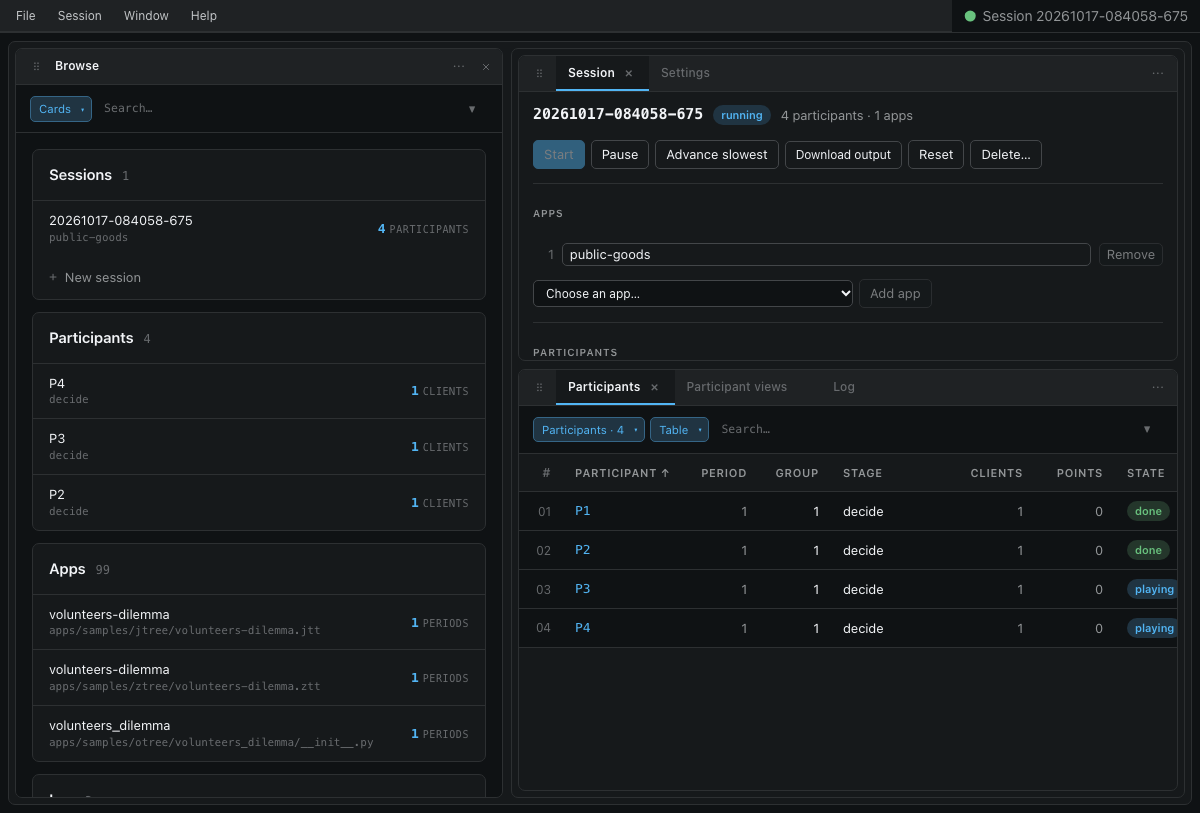
Participants open the address the Session panel shows, http://<this computer's address>:3000/P1 and so on. To try the session on your own, open participants from the Participants panel, or turn Autoplay on. For more, see Running a Session.
Stop jtree
- Close the launcher's window (or press Ctrl+C in it).
Run your own experiment
-
Put your files in the
client/appsfolder, then use File → Reload apps in the admin (or start jtree again). jtree runs:- jtree apps: a
.jttfile, or a folder with anapp.jtt(see Designing an App); - queues: a
.jtqfile that lists apps to play one after another, an app whose stages are those apps (see Queues); - z-Tree treatments and questionnaires:
.ztt,.ztq, or z-Tree's text export (see z-Tree treatments); - oTree apps and projects: a folder with oTree's
__init__.py(ormodels.py), or a project with itssettings.py(see oTree apps).
- jtree apps: a